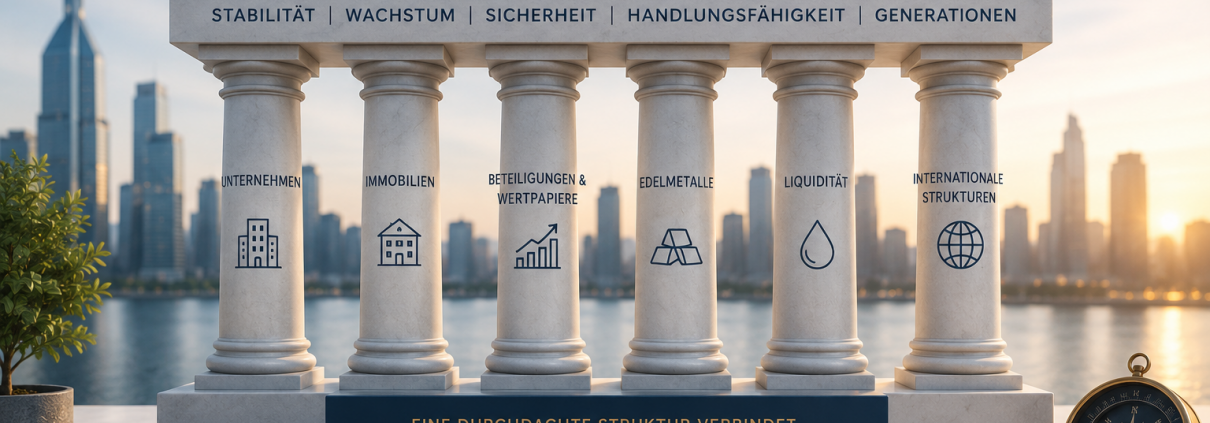
Wealth architecture begins long before business succession
In recent years, I have had the privilege of assisting numerous entrepreneurial families with business valuations, business succession planning, and the structuring of entrepreneurial wealth.
In doing so, I have repeatedly encountered a similar pattern:
It wasn’t the company that posed the greatest challenge – it was the structure of the accumulated wealth. Many successful entrepreneurs invest all their energy over decades into building their companies. This results in stable business models, jobs, and sustainable value creation. The profits generated are then often transferred to a holding company or into their personal assets.
However, this is precisely where a new entrepreneurial task begins. For alongside the operating company, a second system emerges: the assets. Business Assets Require Their Own Strategy In practice, wealth is often built up step by step. A real estate property results from an interesting opportunity. An equity investment is acquired based on a recommendation. Precious metals serve to protect wealth. A securities portfolio develops over the years. Each individual investment can make sense.
The crucial question, however, is:
What role does it play within the overall wealth architecture?

A successful entrepreneurial career is crowned by a successful business transfer. According to a study by the IfM Bonn, approximately 190,000 businesses are expected to be transferred between 2022 and 2026; most of these will be in Bavaria, Baden-Württemberg, and North Rhine-Westphalia. When attempting to structure business transfers, there are essentially only three options.

A survey conducted by the DIHK in mid-2023 among more than 3,500 companies in Germany shows that plans for industrial relocation are intensifying.
Nearly one-third of industrial companies (31.7%) are planning or already implementing the relocation of capacity abroad or the reduction of domestic production in response to energy policy conditions.