Wealth architecture and business succession are inseparably linked.
Many entrepreneurs invest decades in building their businesses but fail to develop a structured wealth architecture that would facilitate the transfer of assets during succession.
by Dr. Heribert Warken
Introduction
Wealth architecture for entrepreneurs begins long before business succession.
Many entrepreneurs invest decades in building their businesses, yet fail to develop a structured wealth architecture in parallel to secure their assets for the long term and structure them in a way that supports succession.
In recent years, while advising on numerous business succession cases, I have repeatedly observed a similar pattern:
The business itself was not the real problem – rather, it was the structure of the accumulated wealth.
Many successful entrepreneurs focus for decades on building their operational business. With great dedication, they create value, develop their workforce, and generate profits.
These profits are then often channeled into a holding company or into personal assets.
From this point on, however, the scope of the task changes.
This is because, alongside the operating company, a second system now emerges: the asset portfolio.
In practice, however, this portfolio is often not built up according to a long-term strategy. Individual investments are made based on recommendations from one’s personal circle, conversations with friends or business partners, or simply because an interesting opportunity arises.
Each individual decision may make sense on its own.
Taken as a whole, however, the result is often not a wealth architecture, but rather a collection of disparate assets without clearly defined roles within an overarching system.
It is particularly in the context of business succession that the consequences of a lack of structure become apparent. What has grown organically over many years often must first be reorganized, structured for tax purposes, and strategically aligned during the succession process.
In my view, wealth architecture should therefore not begin only with succession.
It should be developed in parallel with the accumulation of wealth.
After all, in the long term, it’s not just about building wealth, but about structuring it in such a way that it remains flexible, transparent, and resilient across generations.
Wealth architecture is a system
A successful company consists of numerous interlocking functions. Production, sales, finance, and controlling each fulfill different roles.
The same principle applies to both personal and business wealth.
Each asset class performs its own function within the overall system.
It is the interplay of these functions that creates stability, flexibility, and long-term capacity for action.
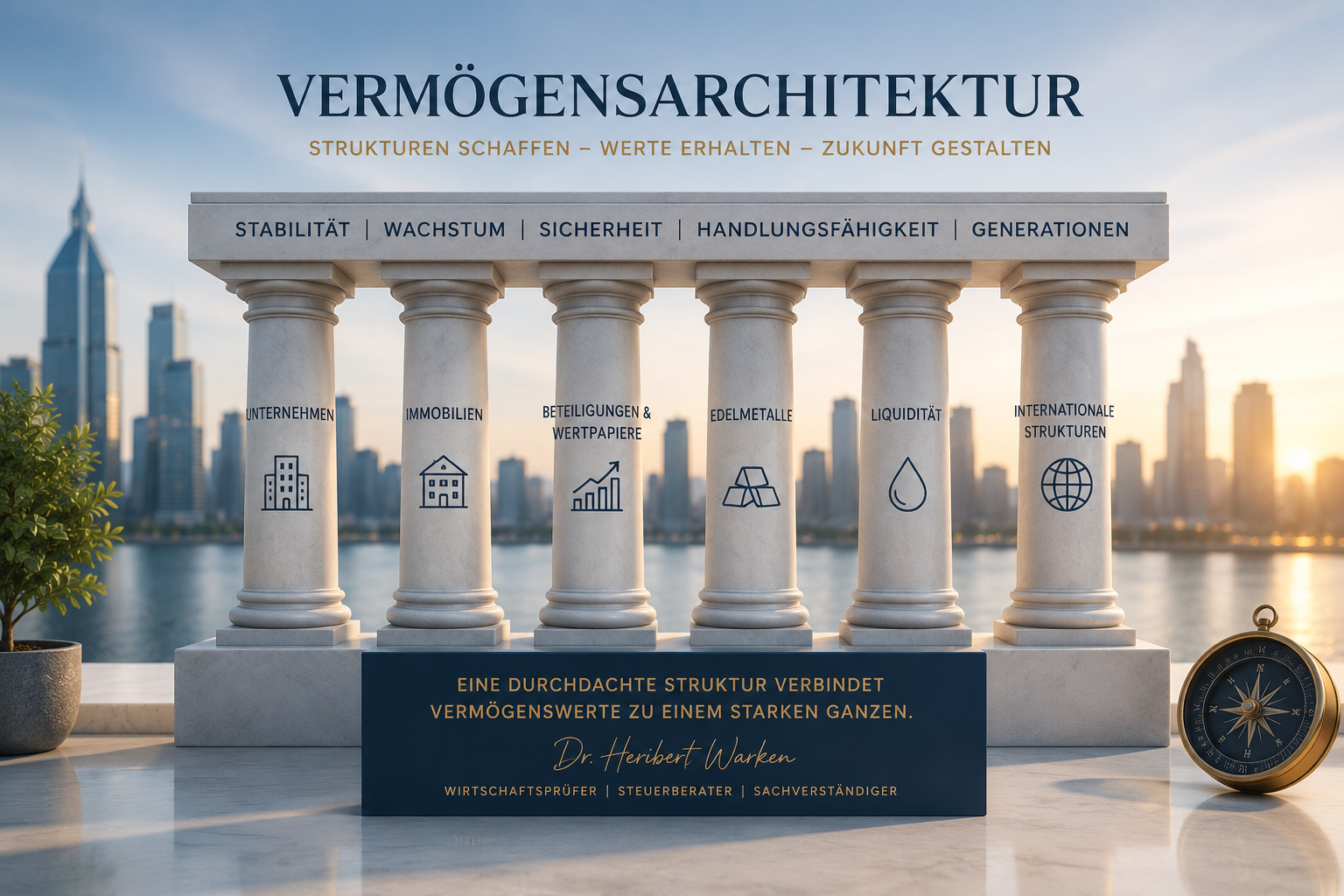
The roles of individual asset classes
An asset architecture may, for example, include the following building blocks:
Businesses
They generate value and often form the source of wealth.
Real Estate
It provides stability, ongoing cash flows, and protection against inflation.
Equity Investments and Securities
They enable long-term growth and international diversification.
Precious Metals
They serve to protect wealth during times of economic uncertainty.
Liquidity
It enables the ability to act. Opportunities can only be seized if sufficient liquidity is available.
International Structures
They reduce concentration risks and open up additional economic opportunities.
None of these asset classes is the “best” form of investment on its own. Their significance stems exclusively from their function within the overall system.
The real question
In my view, the crucial question is not:
“Which asset class is the best?”
But rather:
“What role does this asset class play within my overall wealth architecture?”
This perspective often changes the entire outlook on wealth management decisions.
Typical weaknesses
In practice, I regularly encounter similar structural problems:
- high concentration of assets in a single asset class,
- lack of liquidity reserves
- inadequate estate planning
- structures that are not tax-optimized
- lack of international diversification
- lack of coordination between personal and business assets.
These risks rarely arise from individual investments. They arise from a lack of architecture.
Wealth architecture is long-term thinking
Wealth does not grow through short-term market movements. It grows through consistent structural work over many years.
That is why I view wealth architecture as an ongoing process.
The goal is to structure assets in such a way that they
- generate returns,
- mitigate risks,
- ensure liquidity,
- bridge generations, and
- create long-term stability.
Especially in these turbulent times of transformation, it is important to build resilient wealth structures. Unlike just a few years ago, small and medium-sized enterprises are now forced to adopt a more international approach and tap into sources of income outside their home country.
However, these structures cannot be built overnight; they must be planned in advance.
That is why it is essential to start building these structures now.
Conclusion
Entrepreneurs who achieve long-term success do more than just invest capital.
They develop structures!
A well-thought-out wealth architecture combines different asset classes into a robust, resilient overall system. It is not individual investments that determine the sustainable, intergenerational preservation of wealth. What matters most is the architecture in which they are embedded.
About the Author
Dr. Heribert Warken is a certified public accountant, tax advisor, and expert in business valuation.
His practice focuses on business valuation, business succession, wealth architecture, and the structuring of entrepreneurial and real estate assets both domestically and abroad.
